

Anger is a normal human emotion.
We all experience it. Sometimes anger tells us that a boundary has been crossed, something feels unfair, or an important need is not being met. Anger can even motivate us to speak up, protect ourselves, or make a change.
The difficulty is not necessarily feeling angry.
The difficulty can arise when anger feels overwhelming, happens frequently, or leads to reactions that you later regret.
You might find yourself raising your voice during an argument, becoming impatient over small frustrations, replaying situations in your mind, or feeling as though your anger takes over before you have a chance to respond differently.
As therapists, we often help clients understand that anger is not something they need to eliminate. Instead, therapy can help you understand what happens underneath your anger and develop more effective ways of responding to it.
One approach that can be particularly helpful is Cognitive Behavioural Therapy (CBT).
CBT for anger management can help you recognize the relationship between your thoughts, emotions, physical responses, and behaviours. By becoming more aware of these patterns, you can begin creating more space between feeling angry and acting on that anger.
What Is Anger?
Anger is an emotional response that can arise when we perceive that something is wrong, threatening, unfair, frustrating, or outside our control.
It can range from mild irritation to intense anger or rage. Anger can also show up physically.
You might notice:
- A faster heartbeat
- Muscle tension
- Clenched fists or jaw
- Feeling hot or flushed
- Faster breathing
- Restlessness
- An urge to argue or act immediately
These physical changes are part of the body’s response to emotional activation.
One important distinction is that feeling angry and acting on anger are not the same thing.
You can experience intense anger without yelling, insulting someone, breaking something, or making a decision you later regret.
That space between emotion and action is where many anger-management skills begin.
What Is Cognitive Behavioural Therapy?
Cognitive Behavioural Therapy is a structured, evidence-based form of psychotherapy that focuses on the relationship between thoughts, emotions, physical responses, and behaviours.
A basic CBT model looks at how these parts influence one another:
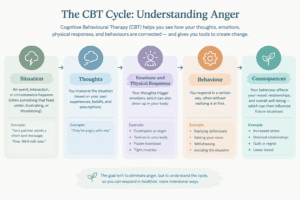
Consider a simple example.
Someone sends you a short text message:
“Fine. We’ll talk later.”
You might immediately think:
“They’re angry with me.”
That interpretation could lead to anxiety, frustration, or anger, along with physical tension.
You might then respond:
“If you have something to say, just say it.”
The other person becomes defensive, and an argument begins.
CBT does not ask you to pretend the situation did not happen or convince yourself that everything is fine.
Instead, it helps you slow the process down and examine what happened between the event and your reaction.
You can begin asking questions such as:
- What did I assume was happening?
- What was I telling myself in that moment?
- Was there another possible interpretation?
- What response would be more consistent with what I actually want?
This process can create more choice in situations where anger previously felt automatic.
Looking Beneath Anger
Anger is often the emotion we notice first.
Sometimes, however, other emotions or experiences may be present alongside it.
For example, anger can occur alongside:
- Hurt
- Fear
- Rejection
- Shame
- Disappointment
- Anxiety
- Feeling powerless
- Feeling misunderstood
This does not mean that every experience of anger is hiding another emotion.
However, exploring what anger may be communicating can provide useful information.
A therapist might ask:
- What did that situation mean to you?
- What were you telling yourself in that moment?
- What did you need that you were not getting?
- What happened in your body before you reacted?
These questions can help you move from seeing anger as something that simply happens to you toward understanding the experiences and patterns that contribute to it.
Identifying Your Anger Triggers
One of the first steps in CBT-based anger management is learning to recognize patterns.
Anger rarely appears completely out of nowhere. There may be specific situations, thoughts, relationships, or circumstances that make anger more likely.
Common triggers can include:
- Feeling criticized
- Feeling ignored
- Conflict with a partner
- Parenting stress
- Workplace frustration
- Feeling disrespected
- Financial pressure
- Lack of sleep
- Feeling out of control
- Repeated misunderstandings
- Accumulated stress
Keeping track of these patterns can help you identify situations where you may need additional coping strategies.
The goal is not to eliminate every trigger. Life will always include frustrating moments.
Instead, the goal is to become better at recognizing:
“I’m becoming activated.”
Recognizing that earlier can make it easier to choose what happens next.
Recognizing Thoughts That Fuel Anger
CBT places particular emphasis on the way we interpret situations.
Two people can experience the same event and respond very differently because they understand or interpret the event differently.
Certain thinking patterns can intensify anger.
“They Always Do This.”
Words such as always and never can make a frustrating situation feel larger and more permanent.
You may feel as though the current problem represents every previous disagreement, which can make it harder to respond to what is happening right now.
“They Don’t Respect Me.”
This may be an understandable interpretation, particularly if you have experienced repeated frustration with someone.
CBT can help you explore whether there are other possible explanations while still taking your feelings seriously.
“They Did That on Purpose.”
Assuming another person’s intention can quickly intensify an emotional reaction.
Sometimes we know that someone’s behaviour was intentional. Other times, we may be filling in information that we do not actually have.
“I Have to Respond Right Now.”
This thought can create a sense of urgency and make it harder to pause.
You may not actually need to respond immediately, even when your emotions tell you that you do.
“If I Don’t Stand Up for Myself, People Will Walk All Over Me.”
For some people, anger can feel protective.
CBT can help explore whether there are ways to maintain boundaries and stand up for yourself without relying on aggression or losing control.
CBT is not about replacing every negative thought with an artificially positive one.
Instead, the goal is to develop thoughts that are more balanced, accurate, and helpful.
Creating Space Between Anger and Action
One of the most important parts of anger management is learning that you do not have to act immediately on an emotion.
When anger is intense, your body may feel as though immediate action is necessary.
Taking a pause can create an opportunity to choose a different response.
Depending on the situation, that pause might involve:
- Taking several slow breaths
- Stepping away from an argument
- Going for a short walk
- Drinking some water
- Waiting before sending a message
- Using grounding techniques
- Naming what you are feeling
- Returning to the conversation once you are calmer
Taking a break is not necessarily avoidance.
When communicated respectfully, it can be a way of protecting a relationship and giving yourself time to respond intentionally.
For example:
“I’m too activated to have this conversation productively right now. I need some time, and I’d like to come back to this later.”
This is different from leaving an interaction with the intention of punishing or intimidating someone.
The goal is to create enough space for you to regain control of your response.
Learning to Communicate Anger More Effectively
Anger can contain important information.
The goal of anger management is not necessarily to suppress it. Instead, therapy can help you communicate what is underneath your anger without attacking another person.
Consider the difference between:
“You never listen to me.”
and:
“I felt dismissed when I was interrupted, and I need a chance to finish what I was saying.”
The second statement still communicates frustration. However, it also gives the other person information about your experience and what you need.
This is where assertiveness can be helpful.
Being assertive allows you to communicate boundaries, concerns, and needs without relying on aggression.
You can be angry without being threatening.
You can set a boundary without insulting someone.
You can disagree without trying to hurt the other person.
You can speak up for yourself without losing control of your behaviour.
CBT for Anger in Relationships
Anger can be particularly difficult within close relationships.
When we care deeply about someone, their words and actions can have a greater emotional impact on us.
Arguments can also develop into familiar cycles.
One person becomes angry and raises their voice.
The other person becomes defensive or withdraws.
The first person feels even more ignored and pushes harder.
The other person withdraws further.
Eventually, both people may feel misunderstood.
CBT can help individuals recognize these patterns and examine the thoughts, emotions, and behaviours that keep them going.
For couples, therapy can also provide a space to work on communication, conflict resolution, emotional regulation, and relationship needs.
The goal is not necessarily to determine who is “the angry person.”
Instead, therapy can help identify the cycle that both people may have become caught in and explore healthier ways of responding to one another.
Anger, Stress, and Emotional Regulation
Sometimes anger does not occur in isolation.
When you are already exhausted, overwhelmed, or under chronic stress, your emotional threshold may be lower.
A minor frustration that would normally feel manageable can feel much bigger after a difficult day.
This does not excuse harmful behaviour.
However, understanding the role of stress can help explain why anger may feel harder to manage when you are depleted.
CBT-based therapy may therefore include broader strategies for managing stress, improving problem-solving, recognizing early warning signs, and developing healthier routines.
Learning to manage anger can involve looking not only at what happens during an argument, but also at what is happening in your life before the argument begins.
Anger Management Is Not About Becoming Passive
Some people hesitate to work on their anger because they worry that becoming “less angry” means becoming passive.
It does not.
Healthy anger can help us recognize boundaries and communicate that something matters.
Anger management is not about becoming someone who never speaks up.
It is about learning how to speak up without losing control of your behaviour.
You can be assertive without being aggressive.
You can have boundaries without threatening someone.
You can disagree without trying to hurt the other person.
You can feel angry without allowing anger to make every decision for you.
When Should You Consider Anger Management Therapy?
It may be worth speaking with a therapist if anger is regularly affecting your relationships, work, family life, or overall wellbeing.
You might consider support if:
- Your anger feels difficult to control
- You frequently regret things you say or do when angry
- Arguments regularly escalate
- People close to you seem afraid of your reactions
- You yell, insult, threaten, or act aggressively during conflicts
- You find yourself holding onto anger for long periods
- You experience intense physical activation when frustrated
- Anger is affecting your relationship or parenting
- You have difficulty calming down after conflict
- You want to develop healthier ways of handling frustration
Seeking therapy does not mean that you are a bad person.
It means that you have recognized a pattern that you would like to understand and change.
You do not have to wait until anger has caused a major problem before seeking support.
What Happens in CBT for Anger Management?
CBT for anger management is individualized. Your therapist may work with you to understand your particular triggers, thought patterns, emotional responses, and behaviours.
This may include:
Identifying Anger Patterns
You can explore when anger tends to appear, what circumstances contribute to it, and whether particular relationships or situations make it more likely.
Recognizing Early Warning Signs
You can learn to notice physical sensations, thoughts, and behaviours that occur before anger reaches its peak.
Examining Unhelpful Thinking Patterns
You can explore interpretations or assumptions that may be intensifying your emotional response.
Developing Coping Strategies
You can build practical skills for managing emotional activation and creating more space before reacting.
Practicing Communication Skills
You can learn ways to express needs, boundaries, and concerns more effectively.
Working on Problem-Solving
You can identify realistic solutions to recurring sources of frustration instead of remaining stuck in the same cycle.
Strengthening Emotional Awareness
You can develop a greater understanding of anger and other emotions that may occur alongside it.
The therapist’s role is not to tell you that your anger is wrong.
It is to help you understand your anger and develop more choices around how you respond.
What If Anger Is Connected to Trauma or Other Mental Health Concerns?
For some people, anger may be connected to experiences such as trauma, chronic stress, anxiety, depression, relationship difficulties, or other mental health concerns.
In these situations, simply learning to “control your temper” may not address the broader issue.
A therapist can help explore the context surrounding your anger and determine what kind of support may be most appropriate.
This can be particularly important when anger is accompanied by significant distress, aggression, substance use, thoughts of self-harm, or concerns about someone’s immediate safety.
If there is an immediate risk of harm to yourself or someone else, seek emergency or crisis support rather than relying on outpatient therapy alone.
Anger Can Become an Opportunity for Change
Anger is not your enemy.
It is an emotion, and like other emotions, it can provide information.
Sometimes it tells us that something matters.
Sometimes it signals that a boundary has been crossed.
Sometimes it appears when we are hurt, frightened, exhausted, or overwhelmed.
The goal of anger management is not necessarily to eliminate that signal.
It is to learn how to listen to it without allowing it to control your actions.
CBT can provide a practical framework for doing this. By understanding the relationship between thoughts, emotions, physical responses, and behaviours, you can begin creating more space between what you feel and what you do.
That space can create room for choice.
CBT for Anger Management in Calgary
If you are looking for anger management therapy in Calgary, CBT can be one approach to consider.
At Innerlogue Therapy & Psychology, our therapists work with individuals, couples, and families experiencing anger, stress, anxiety, relationship difficulties, and other mental health concerns.
Therapy is not about judging you for feeling angry.
It is about understanding what your anger may be communicating, identifying patterns that are no longer serving you, and developing healthier ways of responding.
Innerlogue offers therapy in Calgary from our Kensington, Midnapore, and Harvest Hills locations, as well as virtual therapy across Alberta.
If anger has begun affecting your relationships, family life, work, or overall wellbeing, you do not have to wait until things reach a crisis point before seeking support.
Learning to manage anger is not about becoming less passionate or less assertive.
It is about having more choice in how you respond.
Sometimes, that choice can change not only how you feel, but also how you relate to the people who matter most.